
- CategoryBlog
- Posted14.09.2026
- Time to read5mins
- AuthorOla Szaran
Agentic AI in HR: what it is (and what it isn't)
It's open enrollment week. The same benefits question has landed in your team's inbox fourteen times before lunch. A new joiner's laptop still hasn't shipped because an address field wouldn't validate. And someone is sitting there copying start dates from your ATS into your HRIS by hand. None of it is hard. All of it is your Tuesday.
Two years ago, AI meant "draft me a job description." Now it means "handle these requests end to end." This guide covers what agentic AI is, what it does inside a People Operations team, where it breaks, and what makes it safe to trust.
Agentic AI in HR is software that takes a goal, plans the steps within your permission model and the guardrails you set, and acts across your systems to finish the work. It resolves the request, updates the HRIS, runs the onboarding sequence, rather than just answering a question.
What is agentic AI?
Agentic AI reads the context, plans a sequence of actions toward a goal, carries those actions out across your connected tools, and adapts when something changes mid-process. The word that matters is acts. Earlier AI could tell you the parental leave policy. An agent can confirm your eligibility, generate the letter, update your record, and log the whole thing.
The perceive, reason, act loop
Underneath, an agent runs a loop. It pulls data from the systems you've connected: your HRIS, ticketing, knowledge base, payroll. A reasoning layer reads that context, checks the next steps you've told it to take, and picks the right tool for the job. Then it executes, checks the result, and either moves on or escalates.
What "agentic" adds over a bot
A traditional bot matches a question to a canned answer and stops. Often it isn't even multi-turn or conversational. A chatbot running on a large language model (LLM) can go further: it surfaces information from a knowledge source, links to it, and keeps the conversation going. Agentic AI goes further still. It resolves the request in the thread where the conversation started, so nobody has to open a portal, file a ticket, or chase an update. What separates a bot from an agent is whether the work gets done.
What are AI agents in HR?
An AI agent for HR is software that takes an employee request and finishes it. It reads the request in plain language, checks your system of record, takes the action within the guardrails you've set and the permissions it's been given, and records what it did.
This is what people mean by agentic AI in HR. It doesn't just find the answer for you. It owns the workflow from start to finish, the way a coworker would.
Agentic AI vs generative AI vs automation
Automation runs logic that someone wrote in advance. Generative AI works out a response the moment you ask. Agentic AI uses a model to decide what to do, and then does it.
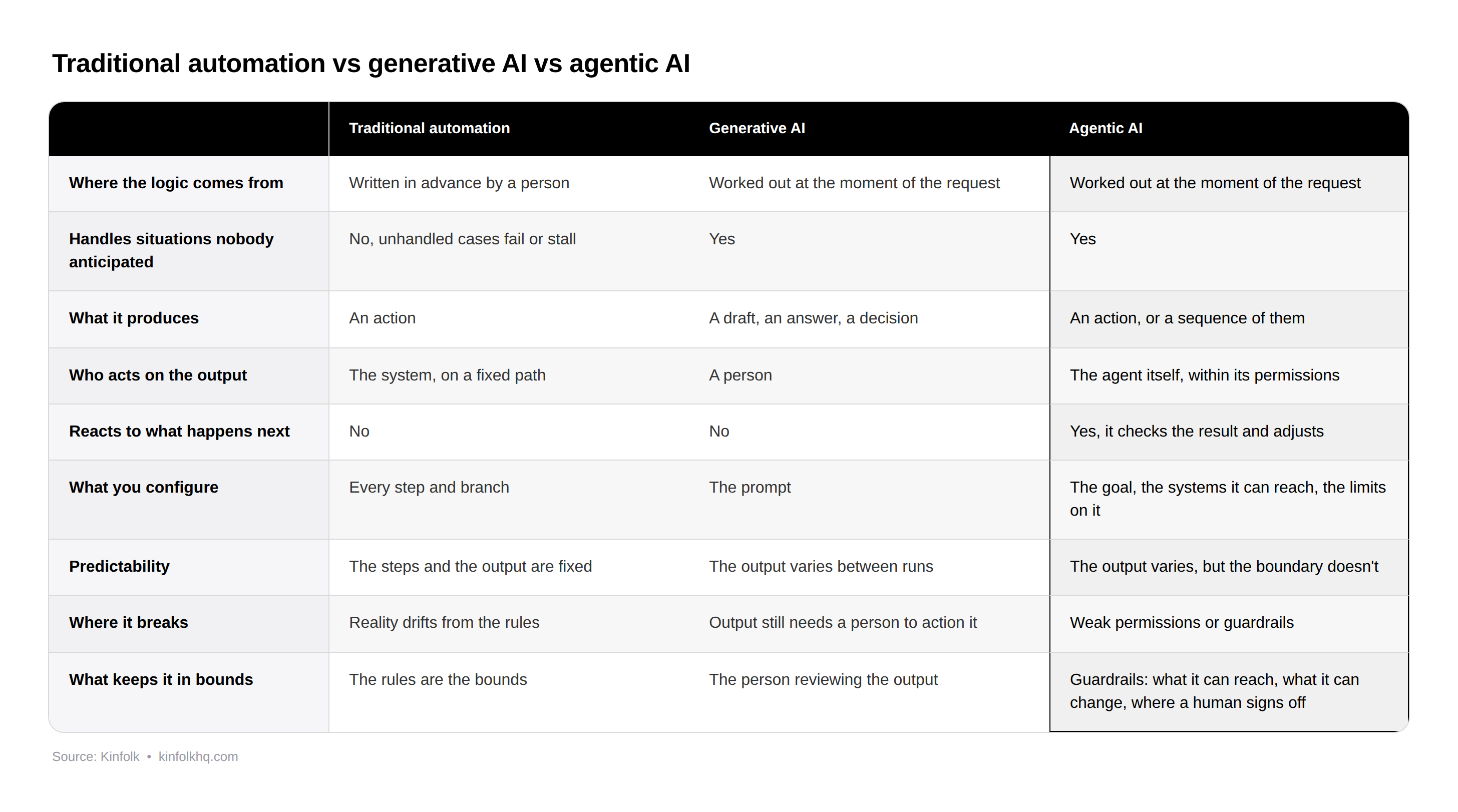
Agentic AI is generative AI given tools, permissions, and a loop. Same engine underneath, more latitude on top. That's why the middle and right columns match on the first two rows.
In practice, an agent is never given free rein. You define the goal, the systems it can touch, the actions it's allowed to take, and the points where a person has to approve. Within those limits it works out its own steps. Outside them it can't act at all. So the question to ask isn't whether it behaves identically every time, because it won't, and neither would a person. The question is how tightly the boundary is drawn and how well you can see what it did.
That's the trade-off worth understanding: predictability versus coverage. Rules are cheap and exact, so they're right wherever the process really is fixed. A model earns its place where the input varies too much for rigid rules to drive the right action, and where having a person handle every step is the bottleneck.
What agentic AI does in HR
Agentic AI earns its keep on high-volume work where the policy and process are clear but the requests aren't. Think Tier 0 and Tier 1 questions and the lifecycle coordination that quietly eats a People Ops week. Where a process is fully specifiable, a workflow tool is the cheaper and more auditable answer. The case for agents is everything else: requests arriving in whatever words someone happened to use, cases that turn on a detail nobody thought to ask for, and the exceptions and chasing across systems that hardcoded flows leave to a human.
That's a narrower claim than "AI reinvents talent strategy," and a more useful one. Most of the market is still in the trying-it phase rather than the running-it phase. McKinsey's State of AI finds far more organizations experimenting with agents than have scaled them into daily operations.
Employee requests and the service desk
This is the clearest fit. Employees ask the same things constantly. How much PTO do I have left? How do I add a dependent? Where's my letter for the visa office? An agent can read the request in Slack, check the policy, confirm the balance against the HRIS, take the action, and close it out, with an audit trail behind it.
A help desk that routes tickets moves the work to someone else. One that resolves them removes it. Most People teams didn't set out to run a ticket queue, and agentic AI is how you stop.
Onboarding and offboarding
Onboarding involves more coordination than anyone remembers until it breaks. Document collection, IT provisioning, access grants, benefits prompts, first-week intros, all across multiple systems, all on a deadline. An agent can orchestrate the sequence, follow up on the step that stalled, and escalate only what needs a human call.
Offboarding is the same shape in reverse, and the stakes are higher: deprovisioning on the day, not the week after.
Benefits, compliance, and the record that follows
Benefits enrollment, policy acknowledgments, certification reminders, jurisdiction-specific checks. This is agentic AI in HR at its most valuable, because the work is repetitive and the cost of getting it wrong is real, and it can run inside the same approval gates and permissions as everything else.
The gain most teams underestimate is the reporting. When an agent handles requests, every action is logged, so you can see where employees get stuck and where your team's time goes. If you want the full picture, the operational use cases across HR run wider than most teams expect.
Autonomy inside guardrails
Good agentic AI is autonomous inside guardrails you define. It runs the routine steps on its own and hands you the ones that need judgment. The question to ask is whether it acts within limits you set and can inspect.
Four controls turn autonomy into something you can run:
- Scoped permissions decide what data an agent can see and which actions it can take on its own. Least privilege, by default.
- Fixed paths for sensitive actions. A payroll change or a termination follows the same defined route every time, with the approval gates built in.
- An audit log records every action and the reasoning behind it, so nothing an agent does is a black box.
- Escalation thresholds define exactly when the agent stops and asks a person, and who that person is.
Autonomy without governance is exposure. An agent that acts fast on the wrong data, with no record and no off-ramp, will cost you more than the manual process it replaced. This is also why the market is more cautious than the headlines suggest. Gartner found that just 15 percent of IT leaders are considering, piloting, or deploying fully autonomous agents. The rest keep a human in the loop, and the guardrails are what change that calculation. Every action Kin takes runs inside those four controls.
Where agentic AI breaks in HR
Agents fail less on model quality and more on governance, data, and scope. It's worth knowing where before you hand over a workflow, because the failure modes are predictable, which means they're preventable.
Bad data is the big one. An agent working across an ATS and an HCM that disagree on someone's start date will make a confident decision on the wrong input. The failure is in the data, and an agent acting on it at speed creates more mess than a slow manual process would.
Then there are cascading errors, one misclassified request propagating silently through connected systems. There's the hallucinated policy answer, delivered with total confidence. There's the compliance gap, where an action can't be proven because nothing logged it. And there's the over-scoped pilot that never shows clear value. Gartner expects over 40 percent of agentic AI projects to be canceled by the end of 2027, on escalating cost, unclear value, and weak risk controls. Deloitte makes a related point: deployment is outpacing the controls around it.
Each of those has a control that answers it. Clean, reconciled data before you automate on it. Scoped permissions so a single error can't cascade. Grounded answers tied to your policies, not the open web. The audit log for compliance. And a narrow, measurable first workflow instead of a moonshot. None of this is a reason to wait. Start narrow, on work you can measure, where the data is already clean.
What you get back when it works
When agentic AI works in HR, you get three things back: capacity, consistency, and a record of what happened.
- SonderMind resolved 95 percent of HR tickets with Kin in the first month.
- Deliveroo cleared 5,000 HR requests in five months, across 10 markets and 4,000 employees.
- Hudl now handles 70 percent of employee requests without escalation, and cut onboarding sessions from 60 minutes to 20.
- RetailNext cut its Jira tickets in half and scaled support without adding headcount.
Across customers, Kin handles an average of 80 percent of Tier 0 and Tier 1 employee requests without human intervention. Meanwhile, satisfaction on escalated cases climbs to 4.5 out of 5, which means automating the routine work lets the team deliver a better service on the cases that do reach them. You can read the full HR service delivery results behind each of those figures.
The orchestration layer is what lasts
Models improve, apps get replaced, and agents will look different in a year. What lasts is the layer underneath them: the integrations, permissions, auditability, and workflows that make execution reliable across systems, teams, and time.
It's also the answer to build versus buy. With today's models, you can wire an agent to your HRIS and reach a working prototype in a week or two. Keeping it governed, permissioned, audited, and still working the day after a Workday update, a new benefits vendor, or a reorg is the hard part, and it doesn't end. Every integration is a relationship you now have to maintain. Every permission is a decision you have to keep current. Every audit trail is only useful if it survives the next migration. That maintenance is the product.
We've written more on building versus buying an HR AI tool. The short version: the moat sits in the orchestration layer, not the model.
How to start with agentic AI in HR
Pick one high-volume workflow where the data is already clean, set the scope and escalation rules, prove it, then expand. Resist the end-to-end moonshot, because that's the pilot most likely to stall.
Start where the pain is loudest and the rules are clearest: PTO questions, policy lookups, a single onboarding sequence. Get your inputs in order first, because an agent inherits whatever your data and permissions already are. Define what the agent can do on its own and where it must escalate, so it's clear who owns each decision. Then measure. Which requests it resolves, where friction remains, how the numbers move, and use that to widen the scope.
If you're not sure your team is ready, check how AI-ready your People Ops team is first. And if you want to see what this looks like on your own systems, book a demo.
Frequently asked questions
What is agentic AI in HR?
Agentic AI in HR is software that takes a goal, plans the steps, and acts across your HR systems to complete work. It resolves a request, updates the HRIS, runs an onboarding sequence, rather than only generating an answer. It works without step-by-step direction, inside permissions and escalation rules you define.
Is agentic AI the same as an HR chatbot?
No. A chatbot matches a question to a scripted answer and stops at the reply. Agentic AI takes action across your systems. It completes the form, updates the record, triggers the workflow, and escalates what needs a person. The difference is whether the request gets resolved or just answered.
How is agentic AI different from HR automation?
Traditional HR automation runs a fixed rule when a trigger fires, and stops the moment something unexpected happens. Agentic AI pursues a goal and adapts when conditions change, whether that's a stalled provisioning ticket, a shifted start date, or a missing field, within the paths and permissions it's given.
Is agentic AI in HR safe and compliant?
It can be, if it's governed. Safety comes from scoped permissions, fixed paths with approval gates for sensitive steps, and an audit log that records every action and its reasoning. That traceability is what makes agentic AI something you can expand over time. An agent with no guardrails and no record is a liability, so governance comes first.
Where does agentic AI in HR still need a human?
Anywhere judgment, empathy, or ambiguity is involved: sensitive cases, exceptions the data can't resolve, decisions with consequences for a person. Well-designed agents are built to recognize those moments and escalate them rather than push through. The aim is to give the team back the hours the repetitive work was taking.